How an RO purifier differs from an ordinary water filter
Understanding reverse osmosis, 0.0001 micron filtration, TDS readings, and the waste-water question.
Water filters come in many forms, but the one people ask about most is RO — how it differs from an ordinary filter, and whether it is really necessary.
Filtration fineness is the clearest difference
Ordinary filters using sediment and carbon cartridges work at roughly 1–5 microns. That is enough for dust, rust and sand, and it reduces chlorine odour — but it cannot block substances dissolved in the water.
A reverse-osmosis membrane filters down to 0.0001 micron, tens of thousands of times finer, small enough to block up to 99.99% of bacteria, viruses, heavy metals and dissolved solids.
What TDS tells you
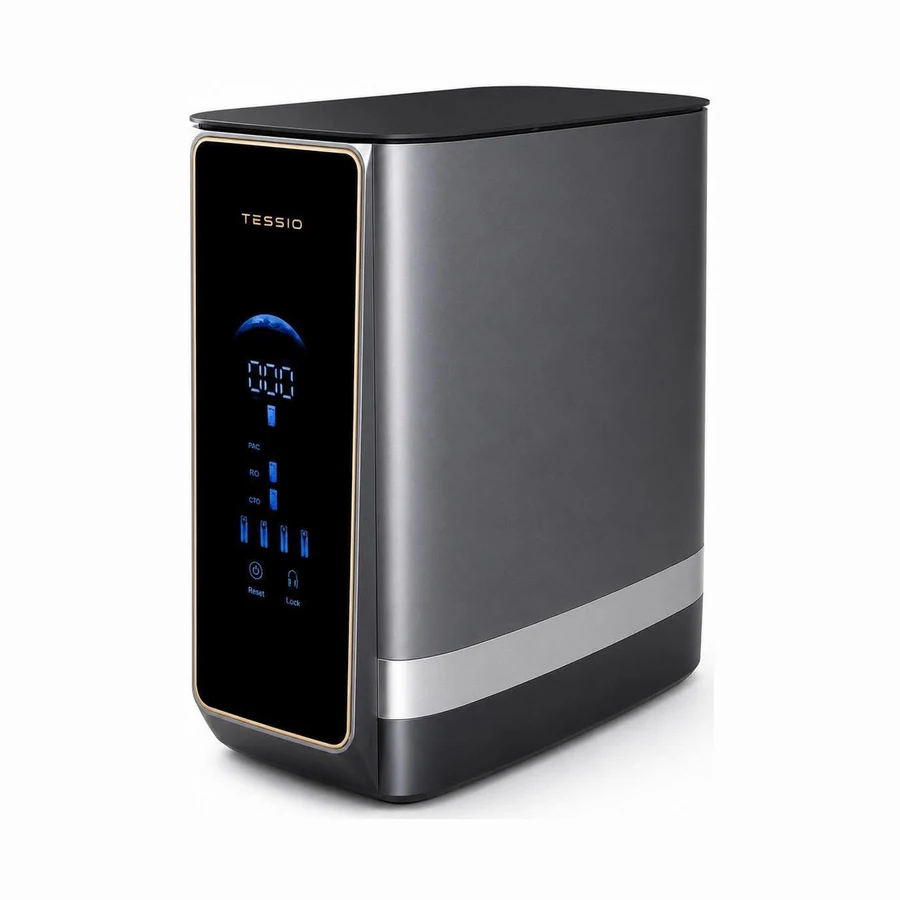
TDS stands for Total Dissolved Solids, measured in ppm. Several TESSIO purifiers display TDS for both incoming and filtered water, so you can see the unit working.
A very low TDS is not automatically the best water, because beneficial minerals are removed too. That is why newer models such as AQUALUXE add an alkaline stage at the end to return minerals and bring the pH back to weakly alkaline.
The waste-water question
RO systems need some waste water to flush contaminants off the membrane surface. Older units discarded as much as three parts waste to one part clean. Newer designs have improved considerably — AQUALUXE runs at 2:1, two parts pure to one part waste.
Tank versus tankless
Tank-based RO units filter water in advance and store it, which dispenses quickly but needs space and leaves water standing. Tankless units filter on demand, so they need a high-flow pump — 600 gallons per day, for example — to fill a glass in seconds. The benefit is saved space and no standing water.
Check the standard before you decide
The standard to look for in an RO system is NSF/ANSI 58, written specifically for reverse-osmosis drinking water systems. The RO membranes TESSIO uses are certified to it.
Any questions? Message us on LINE at @tessio369.